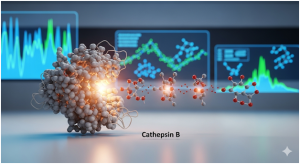
Proteases play a vital role in almost every biological process.
It includes:
- cell signaling,
- immune response,
- tissue remodeling, and
- disease progression.
Cathepsin B stands out as a critical player.
It is highlighted boldly among the numerous proteases studied in molecular biology and biochemistry.
The recombinant Cathepsin B protein has become an essential tool in the protease research toolkit for:
- checking cancer mechanisms,
- neurodegeneration, or
- developing new therapeutic targets.
But why does it matter so much?
Let’s know the significance behind Cathepsin B and see why the recombinant version of this enzyme is more than just another lab reagent.
What Is Cathepsin B?
Cathepsin B is a lysosomal cysteine protease.
It is an enzyme that breaks down proteins.
The process is typically done inside the acidic compartments of cells called lysosomes.
In healthy cells, it helps with:
- normal protein turnover,
- cellular recycling, and
- immune system functions.
However, when dysregulated, Cathepsin B can become a double-edged sword.
Most studies have connected Cathepsin B to pathological conditions.
Those include:
Cancer:
It promotes tumor invasion and metastasis.
That done by degrading the extracellular matrix.
Neurodegenerative diseases:
They contribute to neuronal damage in diseases.
Those include Alzheimer’s and Parkinson’s.
Inflammation:
It can trigger inflammatory responses in autoimmune conditions.
These wide-ranging effects make Cathepsin B a subject of intense research.
That’s where the recombinant version comes in.
What Is Recombinant Cathepsin B Protein?
Recombinant Cathepsin B is a lab-engineered version of the natural enzyme.
It is produced using gene cloning and expression techniques, typically in:
- coli,
- insect, or
- mammalian cells.
The recombinant form is designed to be biologically active, highly pure, and consistent across experiments.
Three major factors make it valuable in research.
Researchers avoid the variability and ethical concerns associated with isolating the protein from animal tissues.
It is done by using the recombinant version.
However, they need a more scalable and standardized tool for scientific exploration.
So, What Makes It Important For Protease Studies?
1. Precision in Enzyme Kinetics
You need to learn how Cathepsin B functions:
- its substrate specificity,
- pH range,
- inhibitor sensitivity.
It requires access to a pure and active enzyme.
Recombinant Cathepsin B allows researchers to measure kinetic parameters with high accuracy.
You get insights into how the enzyme behaves under different conditions.
Precision is crucial when designing inhibitors or modulators for therapeutic use.
2. Modeling Disease Mechanisms
Since Cathepsin B is implicated in cancer progression and neurodegenerative diseases.
When you use recombinant protein, it allows researchers to simulate disease conditions in vitro.
Scientists can observe how the enzyme interacts with substrates or inhibitors.
It can help model key aspects of pathology.
They can learn some potential intervention points.
For example, recombinant Cathepsin B can be used to assess how effectively a drug blocks its matrix-degrading activity in cancer studies. It’s a major step in preventing metastasis.
3. Drug Screening and Development
Pharmaceutical companies heavily rely on recombinant proteins.
The reason is high-throughput screening (HTS) of potential drug candidates.
Cathepsin B can aid in the development of protease inhibitors.
These could serve as treatments for:
- tumors,
- inflammatory diseases, or
- neurodegeneration.
Assays run at a scale with a consistent recombinant protein source.
It increases the chances of identifying potent and selective compounds.
4. Structure Studies
You need to know how Cathepsin B’s structure relates to its function.
It is key to designing smart inhibitors.
Recombinant Cathepsin B can be crystallized for X-ray crystallography.
They can even be used in:
- NMR and
- cryo-EM studies.
It gives researchers a 3D view of:
- the enzyme’s active site and
- how substrates or inhibitors bind.
Finally…
The availability of high-quality recombinant Cathepsin B protein now allows researchers to examine it thoroughly.
Maybe there can be some secrets..
Recombinant Cathepsin B is not just a convenience — it’s a necessity for:
- developing new drugs,
- exploring cellular pathways, or
- validating diagnostic tools
So, if you are planning your protease assays, don’t underestimate recombinant protein.
It could be the key to your next research.