
Testing for substances like THC doesn’t need to involve a laboratory anymore.
In fact, there are methods to do it safely (and pretty accurately) at home.
No matter what reasons you have to test for THC at home (and there can be plenty), there are things you should know first.
So, let’s talk about the main reasons why people test at home, how to perform the test correctly, and what to expect when you get your results.
Also, we’ll talk about a few tips surrounding THC testing at home, so make sure you read to the end.
Let’s get right into it!
Reasons to Test for THC at Home
As we mentioned, there are plenty of reasons to test your body for the presence of THC metabolites.
People often assume that it’s only done for criminal reasons, but that’s the stigma that’s luckily dying out.
Here are the main reasons you might decide to test for THC at home:
- Preparation for pre-employment or employee drug testing
- Probation and legal requirements
- Monitoring your detox journey
- Athletic and sports competition testing
- Preparation for random drug testing if you’re in the military
- General well-being and health monitoring (especially for at-risk teenagers)
How Long Does THC Stay In Your System?
This is a tricky question, and the answer is, unfortunately, it depends.
First off, it’s important to note that home drug tests do not test for the presence of THC in your system.
They react with and detect the metabolites that our body holds on to much longer than the THC substance itself.
And how long these metabolites stay in the system depends on several factors, some more, some less known, like:
- Frequency of use – occasional enjoyment vs heavy use
- The amount of THC use – small doses vs binging
- Method of consumption – vaping, smoking, and/or ingesting edibles
- Lifestyle and metabolism rate – athletic people tend to metabolize substances faster
- Body fat percentage – THC metabolites tend to linger on for longer in people who have more body fat
- Hydration – people who stay well-hydrated flush THC metabolites at a faster rate
- User age – the older we are, the longer it takes our bodies to metabolize substances
THC Detection Windows by Test Type
Now that we’ve covered the main factors that can change the outcome of a THC home test, let’s take a look at some general info on the detection windows of different sample types.
| SAMPLE TYPE | TIMEFRAME OF DETECTION |
|---|---|
| Blood | From 12 hours to 7 days |
| Saliva | From 24 to 48 hours |
| Urine | Up to 30 days ( heavily dependent on amount and frequency) |
| Hair follicles | Up to 90 days |
*Keep in mind that this table is not to be taken literally. It’s an approximate range that heavily depends on the factors we discussed above, especially for heavy users.
How to Perform a THC Test at Home
Most home tests, like the Exploro products THC test, use urine as a sample to test for metabolites.
This means that the detection window can vary from a few days for infrequent users to a whole month for heavy users.
No matter, the testing process should look the same.
Here’s how to approach it:
1. Preparation
First of all, make sure that the test isn’t past its expiration date.
Expired tests often give inconclusive and inaccurate results.
Also, make sure that the packaging isn’t heavily damaged, especially the collection cup.
Then, read the instructions carefully before you begin.
Different test brands can have different indicators and detection times.
2. Sample Collection
Most likely, with a home THC test, you’ll get a sample cup to collect the urine sample.
Make sure that the sample cup packaging isn’t damaged, and that it was sealed before you opened it.
If there isn’t a cup provided with the test, it’s best to get a sterile sample collection cup at the pharmacy or, if that’s unavailable, use a thoroughly cleaned cup you have at your disposal.
To avoid further contamination, wash your hands, and do not touch the inside wall of the sample cup.
Furthermore, it’s important to keep the test and the cup on a dry, clean surface.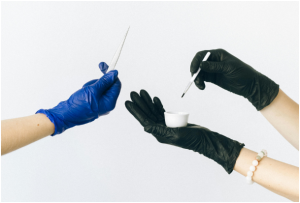
3. Doing the Test
Once you have collected your urine sample, dip the testing strip into it, up to the marked level.
Again, make sure you follow the test instructions to the T.
Once the testing strip has been used, wait for the detection time to pass (usually around 5 minutes).
Now, the test results should be in.
4. Result Interpretation
Most home THC tests look similar to a pregnancy test – there is a control and a test line.
Once the detection period is over, read the results and compare them to the result examples provided with the test kit.
For example, on the strip, you may see a C (control) and a T (test line).
The C line should appear with every valid test, and the T line appears when the test is negative.
Well-designed THC tests have a detection cutoff level of 50 ng/ml (like the official federal tests).
However, sometimes the T-line can show up a little brighter.
A faint line on a THC test is still considered a negative result.
This slightly brighter line can appear due to the fact that the metabolites are still lingering in the system, but below the cutoff level.
THC Home Testing Tips
Here’s a list of a few tips to keep in mind when you decide to do THC testing at home:
- Use first-morning urine – it is more concentrated, and it gives more consistent and clearer results
- Do not overhydrate before the test – this may lead to urine dilution, which introduces the risk of inaccurate results
- Keep your hands, cup, and the test clean – due to the sensitivity of THC testing strips, avoid contamination at all costs
- Repeat the test an odd number of times – if you want to make sure you’re getting consistent results, do a set of 3 or 5 tests
- Read the instructions several times before testing – to get the most accurate results, it’s important to follow the test brand’s instructions
- Store the testing kits properly – a dry place, away from direct sunlight and harsh chemicals, will do the job
Home Test Accuracy
Home THC testing kits are a great way to detect the absence or presence of THC metabolites in urine.
However, this comes with a few caveats.
They do not test for the quantity of the metabolites in your system.
So, look at it in a qualitative, binary way – it’s either positive or negative.
Another thing to keep in mind is that a home THC test isn’t a substitute for a lab test.
Laboratories have access to chromatography analysis tools and methods that are considered the most accurate.
However, home THC testing kits are 95-99% accurate and are a great way to conduct a screening test.
In Conclusion
And there we have it – all the essentials you need to know before you decide to start THC testing at home.
It isn’t exactly rocket science, but it really is important to be prepared and to know what to expect.
After all, medical devices like home THC tests have advanced quite a bit, and there’s no reason not to use them (properly, as discussed, of course).