








What is a Dental Hygienist?
Working as a Dental Hygienist means that you will be up close and personal with patients’ mouths, cleaning their teeth, and checking for cavities.
A Dental Hygienist is the right-hand man to the dentist, assisting with x-rays, teeth cleanings, and many other tasks.
The role of a Dental Hygienist can be a great step into the world of dentistry, or it can become a fascinating career track.
To have great success as a Dental Hygienist, you must be knowledgeable about oral care and have a desire to help those in need.
Duties
You might expect to take a look at people’s teeth in this career, but there are other things that a Dental Hygienist must do on a daily basis.
Some of the things that you can expect to work on as a Dental Hygienist include:
- Screen patients for oral health issues
- Conduct dental cleanings
- Apply treatments for preventative care
- Educate about good hygiene
- Counsel patients
- Take impressions of teeth
Salary
Working as a Dental Hygienist in the United States can offer you around $93,890 a year on average.
Dental Hygienists with a Bachelor’s degree and many years of experience can even expect a salary of over $120,200 a year in some areas.
With minimal experience and education, you will likely make around $66,100 a year to begin.
Many factors can come into play when it comes to salary.
As a Dental Hygienist, working in larger populations and populations with higher socioeconomic statuses can offer more money.
Credentials can provide a higher salary as well.
Specializations and certifications offered through your employer or school are a great place to start.
Annually National Average Salary: $93,890
Average Annual Salary by State
| State | Avg. Annual Salary |
|---|---|
| Alabama | $57,690 |
| Alaska | $118,010 |
| Arizona | $96,050 |
| Arkansas | $85,620 |
| California | $127,090 |
| Connecticut | $96,090 |
| Delaware | $102,530 |
| District of Columbia | $130,850 |
| Florida | $83,270 |
| Georgia | $87,070 |
| Hawaii | $94,340 |
| Idaho | $88,100 |
| Illinois | $86,940 |
| Indiana | $86,310 |
| Iowa | $85,130 |
| Kansas | $82,690 |
| Kentucky | $76,030 |
| Louisiana | $76,190 |
| Maine | $88,390 |
| Maryland | $104,980 |
| Massachusetts | $101,050 |
| Michigan | $80,860 |
| Minnesota | $95,460 |
| Mississippi | $66,490 |
| Missouri | $87,170 |
| Montana | $91,380 |
| Nebraska | $83,540 |
| Nevada | $101,590 |
| New Hampshire | $94,850 |
| New Jersey | $98,490 |
| New Mexico | $93,380 |
| New York | $93,590 |
| North Carolina | $87,770 |
| North Dakota | $85,150 |
| Ohio | $84,160 |
| Oklahoma | $93,940 |
| Oregon | $115,130 |
| Pennsylvania | $83,470 |
| Rhode Island | $81,700 |
| South Carolina | $81,550 |
| South Dakota | $84,780 |
| Tennessee | $83,880 |
| Texas | $89,640 |
| Utah | $84,300 |
| Vermont | $97,370 |
| Virginia | $98,500 |
| Washington | $125,090 |
| West Virginia | $69,660 |
| Wisconsin | $85,590 |
| Wyoming | $81,050 |
| Guam | $60,730 |
Annual Average Salary: Top 5 States
The top earning state in the field is District of Columbia, where the average salary is $130,850.
These are the top 5 earning states in the field:
* Employment conditions may vary by location.
How to Become a Dental Hygienist
Step 1 Earn a Degree
Starting out on your journey to becoming a Dental Hygienist, you will need to have some education.
Many Dental Hygienists choose to enter a dental hygiene program at a trade school or community college, while others choose to earn an Associate’s degree from a college or university.
It’s possible to take classes to become a Dental Hygienist online, however working an internship or doing lab work must be done in person.
Most Associates degrees take around two years to finish, and some Dental Hygienist programs can take anywhere from one year to 18 months to complete.
Some of the classes that you can expect to take in an Associates degree program are:
- Biomedical Science
- Dental Science
- X-rays
- Anatomy and Physiology
Step 2 Become Licensed
Having a degree as a Dental Hygienist is only the first part of the battle.
Next, you will need to take the licensure exam from the National Board of Dental Hygiene.
Some states may require other stipulations before you can become a licensed Dental Hygienist, including:
- CPR Training
- A specific number of hours of dental hygiene experience
- Pass other state certification exams (When applicable)
Some of the areas to study for the National Board of Dental Hygiene Exam are:
- Theory of practice
- Knowledge of procedures
- Medical terminology
The cost for the exam can vary by state, but most cost around $150 to apply for.
This licensure is good for 3-5 years, and in order to become licensed again, you must prove further education.
Step 3 Gain Experience
It may be that you had an internship throughout your schooling and you have landed a great job at a dentist’s office.
If not, there are several ways to gain experience as a Dental Hygienist, in order to make the most out of your career.
Some of the ways to gain exposure to the world of dentistry include:
- Volunteering at summer dental programs for children
- Internships
- Shadowing a Dental Hygienist
- Dental Hygiene sales
- Educating the community on dental health
- Researching and doing lab work
Having hands-on experience in this field is the most crucial way to learn about the career.
Step 4 Further Your Education
Once you have had a couple of years of experience as a Dental Hygienist, it may be time to think about furthering your education even more.
This can be done by earning a Bachelor’s degree in a dental hygiene program or another related area.
There are some colleges that accept Associate’s degree credits and will count them toward a Bachelor’s degree.
If an Associate’s degree credits are accepted, it can take as little as two more years to earn a Bachelor’s degree.
If not, it could take up to four years to finish this degree.
There are several areas that a Bachelors degree program will cover, including:
- Oral Surgery
- Dental Procedures
- Anatomy
- Dental Law and Ethics
These types of degree programs will also provide an internship and clinical lab work so that students have the opportunity to gain more experience through hands-on work.
Having a Bachelor’s degree can make it easier to gain promotions, raises, and lead you to a career beyond a Dental Hygienist including management and eventually working as a dentist.
Recommended Programs
Education
The minimum amount of education required to become a Dental Hygienist is a one-year program.
However, there are many Dental Hygienists who earn an Associate’s degree, which can take about two years to finish.
A one year program can provide entry-level jobs as a Dental Hygienist, but an Associates degree program will help gain raises, promotions, or other positions.
Most dental hygiene programs in community colleges or universities require that their students work an internship and do lab work in a clinical setting.
This provides the students with hands-on experience so that they don’t go into their first job as a Dental Hygienist with no qualifications.
Most programs require math and science skills, as well as a specific set of courses, including:
- Dental Anatomy
- Periodontics
- Restorative labs
- Biomaterials
- Pharmacology
- Head and Neck Anatomy
- Patient Pain Management
Even though there are several one-year programs for Dental Hygienists, most employers require at least an Associate’s degree for entry level jobs.
However, if you are looking to extend your education and career opportunities, you may want to enroll in a Bachelor’s degree program.
These programs can last about four years but offer a variety of knowledge in different subjects.
Bachelors degree programs can offer students the opportunity to learn how to apply anesthesia, as well as other courses such as:
- Humanities
- Radiography
- Special Patients
- Behavioral Science
- Dental Specialties
- Dental Practice Emergencies
Once you have the appropriate education and experience as a Dental Hygienist, you will find that there are many more job opportunities available to you.
Some of the positions that you can expect in this field include:
- Pharmaceutical sales
- Public Health Officer
- Dental Insurance Officer
- Dental Hygiene Program Director
- Hospital/Nursing Home Consultant
Earning a degree is important in this occupation, but the hands-on experience will provide the knowledge needed to extend your career.
Working with a variety of different people will also help, especially when learning about different types of dental issues and procedures.
Career Video Overview
Licensing
After earning a degree as a Dental Hygienist, it is legally required to become licensed.
The American Dental Hygienists Association is an accredited agency all across the United States.
Licensure is a way to show patients and employers that you are competent in your career.
States may have different requirements in order to earn licensure, but most require:
- Graduation from an accredited program
- Passing the national exam
- Passing a state examination
Contact your local licensing agency in your state to find out what the rules are for where you live.
The exam that is required across the country for Dental Hygienists is the National Board Dental Hygiene Examination.
There are many subjects on this exam, including:
- Scientific Basis for Dental Hygiene Practice
- Community Health
- Research Principles
- Clinical Dental Hygiene Services
On this exam, there are multiple-choice questions, fill in the blank questions, as well as statement and answer questions that must be completed.
Tests have around 350 questions, but some will not be graded.
In order to become licensed, you must pass the exam with at least a 75 percent score.
Some states require that Dental Hygienists take another exam in order to gain licensure.
This exam is the state exam, which is required in all states except for:
- Washington
- Oregon
- California
- Colorado
- Minnesota
- Iowa
- Indiana
- Ohio
- New York
- Connecticut
These states allow other forms of continued education as a requirement.
The test that must be taken in order to pass the state exam can vary.
Some states require the Commission on Dental Competency Assessment, other states require the Central Regional Dental Testing examination.
Make sure you understand the requirements for the state that you will be working in, not just living, as they can be different.
Once you become licensed as a Dental Hygienist, you will be able to work legally in any state in the United States.
Example of a Professional Certification:
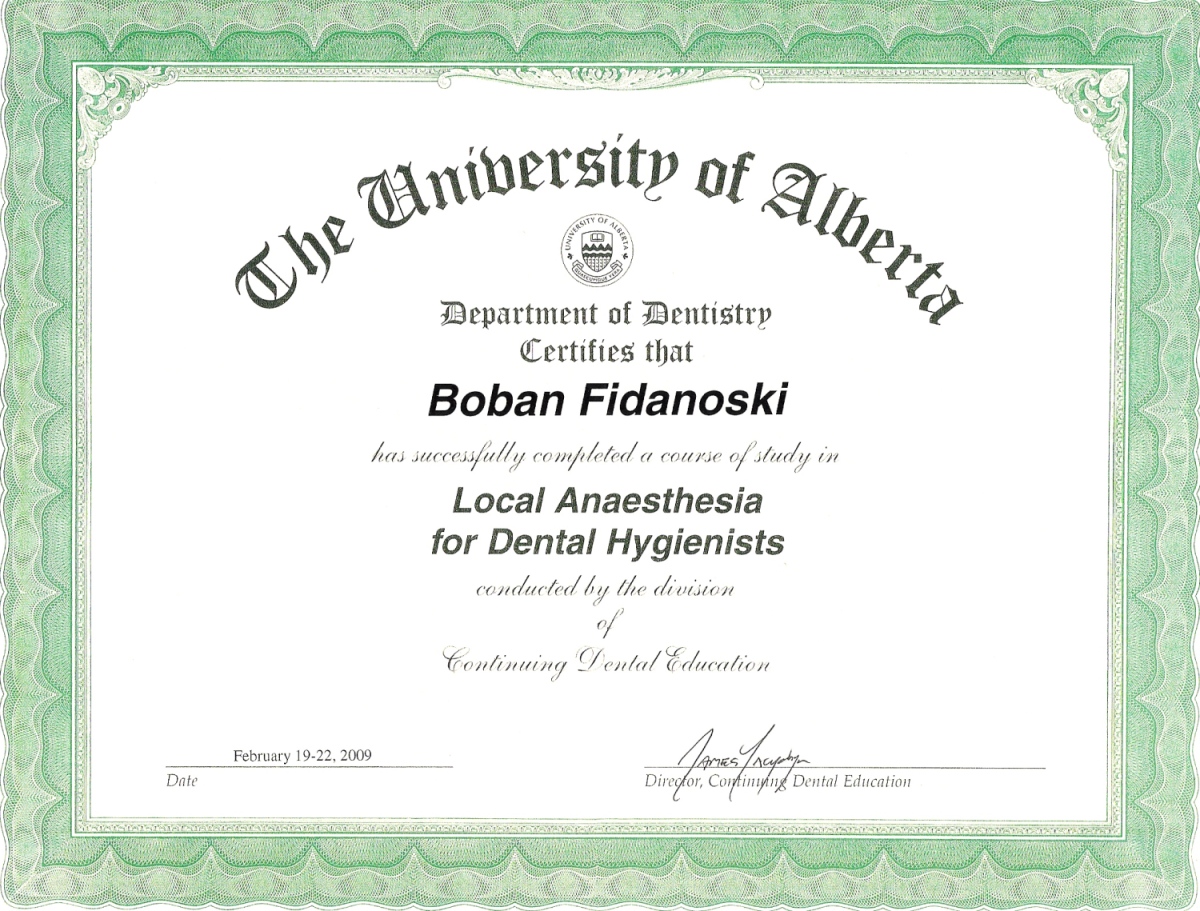
Typical Training Program Length: 1-2 Years
Most training programs to become a Dental Hygienist can take around one year to finish.
Nowadays, many employers are requiring a Dental Hygienist to enroll in a program that is at least two years or longer.
This is to ensure that the student has the experience and knowledge of the dental field.
With clinical lab work, an internship, and any other necessary requirements, it can take anywhere from 1 to 2 years to finish a program and become a Dental Hygienist.
Job Outlook
As the population ages, more people will be in need of dental care.
This is one of the reasons why there will be growth in this career of about 7 percent over the next decade.
Oral health has become increasingly popular over the years, requiring more Dental Hygienists, as well as other occupations in the dental industry.
Some of the aspects that can affect job opportunities in this career are the location of the dental office or medical facility and the socio-economic status of that location.
Larger populations will likely have more career opportunities for Dental Hygienists, especially in areas with higher socioeconomic statuses.
10-Year Employment Growth Rate: 7%
2024
2034
That's a higher than average projected growth of 15,600.
Should You Become a Dental Hygienist?
Overall Satisfaction: High

Dental Hygienist is ranked number one of the best healthcare support careers.
The high salary and the work/home life balance are good for this career, which creates greater satisfaction as well.
There isn’t much upward mobility within this career unless you gain more education, which can make it tedious for some.
If you enjoy working with people and have a desire to educate others on the importance of dental health, then you will be more satisfied in this career.
Earning degrees or certifications can also allow for promotions or raises that can raise satisfaction as well.
Average Salary: High

In the United States, the average Dental Hygienist can make around $93,890 a year.
However, when just beginning a career in this field, you will likely make about $66,100 or less.
After many years of experience and further education, it’s possible to make over $120,200 in some areas as a Dental Hygienist.
Those who work in large populations like California or Washington D.C. will make more money, over $127,000 a year, than someone working in a smaller state.
For example, in Vermont, a Dental Hygienist makes $97,000 a year.
Depending on hands-on knowledge and the area in which you live, working as a Dental Hygienist can offer a great salary.
Job Growth Outlook: Medium

Starting your path toward becoming a Dental Hygienist is a smart idea, as this career will grow around 7 percent over the next decade.
This is about average for all careers in the dental field, due to the necessity for more oral care.
There has been increased popularity in oral health, which has caused an uptick in the demand for Dental Hygienists.
Many laws are being passed which will allow Dental Hygienists even more opportunities in the near future.
Working as a Dental Hygienist will be most satisfactory for those with further education and hands-on experience.
Time to Complete Training: 1-2 Years

Most dental offices require at least an Associate’s degree in order to gain employment as a Dental Hygienist.
The average Associate’s degree program in dental hygiene can take around two years to finish.
This will include any externships or clinical work that needs to be done throughout your education.
Gaining a Bachelor’s degree can be useful for a Dental Hygienist as well.
Depending on the school, this can take another 2-4 years.
It takes anywhere from 2-6 years to become a Dental Hygienist.
Personal Skills Needed

A Dental Hygienist must have good dexterity and be able to work with their hands for a long time.
That’s not the only ability that is required in this career.
Some of the skills that a Dental Hygienist should have include:
- Communication skills
- Attention to detail
- Problem-solving skills
- Ability to read data
- Knowledge of medical tools
- Knowledge of medical terms
- Physical strength and stamina
- Compassion for others
- Empathy
- X-ray skills
- Positive attitude
- Ability to work alone and with other
- Diversity knowledge
Frequently Asked Questions
What is the average salary of a Dental Hygienist?
There are many ways to earn a great salary as a Dental Hygienist.
In fact, on average, this career makes around $93,890 a year.
Having experience and education is a great way to earn more as a Dental Hygienist as well.
Those with hands-on knowledge of the dental industry will make close to $120,200 a year in some areas.
Dental Hygienists who work in states like California can expect larger salaries than someone working in Utah.
Utah boasts an average salary of $84,300 a year, while California claims $127,000 for its Dental Hygienists.
How long does it take to become a Dental Hygienist?
In order to have a great career as a Dental Hygienist, you are going to need to get an education.
Most Dental Hygienists earn an Associate’s degree, which takes around two years to complete.
This will include clinical work, lab work, and an internship.
For those with a desire for more education, they can earn a Bachelor’s degree.
This can take about four years to finish and can open many doors for aspiring Dental Hygienists.
What does a Dental Hygienist do?
A Dental Hygienist is someone who works closely with a dentist in order to make sure the patient’s teeth are healthy.
From exams to x-rays, a Dental Hygienist will look at all parts of your mouth.
They may also clean your teeth, apply sealants, or do other procedures to teeth as well.
A Dental Hygienist will also educate their patients on dental hygiene and oral health in general.
What is the demand for Dental Hygienists?
Oral health is becoming increasingly popular, which means that this career will grow over the next decade.
People who are looking for a career as a Dental Hygienist should start now, as this career is going to rise 7 percent.
Along with many other careers in the medical field, Dental Hygienists will be needed for many years to come.
Demand for Dental Hygienists with education and licensing is higher, and this group will likely find employment faster than those with no education.
How much does it cost to become a Dental Hygienist?
In order to work as a Dental Hygienist, you must earn an Associate’s degree or a Bachelor’s degree.
The most popular degree is an Associates, which can take about two years to finish and costs around $15,000.
Some community college or trade programs can cost less, anywhere from $5,000 to $10,000.
If you are going to earn a Bachelor’s degree, then you should expect to pay closer to $40,000 to become a Dental Hygienist.
Dental Hygienist Resources
- Dental Hygiene Schools
- Dental Hygienist Licensing Requirements
- What is a Dental Hygienist?
- National, Regional and State Dental Hygiene Certification Exams
- 14 Pros and Cons of Being a Dental Hygienist
- How Much Does Going to a Dental Hygienist School Cost?
- 9 Best Online Dental Hygienist Training Programs
Discover Additional Medical Careers
Nursing & Patient Care
 Certified Nursing Assistant
Working as a Certified Nursing Assistant is an entry-level role that will give you hands-on experience when you are ready to take the next step in your medical career.
 EMT
EMTTrained emergency medical technician that arrives at the scene to provide medical services such as resuscitation.
 Home Health Aide
Home health aides provide home care to individuals who require assistance in their day-to-day living.
 Licensed Practical Nurse (LPN)
Licensed Practical Nurses provide basic nursing care to patients and work with Registered Nurses and Doctors.
 Nurse Practitioner
A Nurse Practitioner can diagnose, treat, counsel, and prescribe medications to patients in hospitals or doctors’ offices.
 Patient Care Technician
Patient care techs work directly with patients helping them with daily activities and assist the medical staff by measuring and monitoring the patients' vital signs among other tasks.
 Physical Therapist Assistant
Physical therapist assistants provide physical therapy services to patients and aide to physical therapists.
 Professional Recovery Coach
A professional recovery coach is a life coach who works with someone during their addiction recovery process.
 Registered Nurse (RN)
Registered Nurses provide hands-on patient care in various settings, mainly hospitals, and clinics.
Allied Health & Clinical
 Dental Assistant
Dental assistants help dentists to provide patient care, keep records, and care for the dental equipment.
 Dialysis Technician
Dialysis technicians maintain and monitor dialysis equipment, and also act as primary caregivers for patients undergoing dialysis treatment.

 Medical Assistant
Medical assistants support the work of physicians, nurses, and other health professionals.
 Medical Technologist
Medical laboratory technologists collect bodily samples and conduct tests to analyze those samples.
 Mental Health Technician
A Mental Health Technician is a healthcare support professional who assists licensed clinicians in caring for individuals with mental, emotional, or behavioral conditions.
 Nutritionist
As a Nutritionist, you’ll be tasked with creating meal plans, counseling, and understanding dietary restrictions for all types of clients.
 Optician
Opticians are technicians and salespersons at the same time who spends most of their day talking to customers, reading prescriptions written by doctors, and dispensing glasses and lenses.
 Pharmacy Technician
Pharmacy technicians provide patients with medications through prescription or over the counter.
 Phlebotomy Technician
As a Phlebotomist, it will be your responsibility to take blood samples from patients and send them to the lab for further testing.
 Sterile Processing Technician
A sterile processing technician is a healthcare professional who is responsible for preparing, sterilizing, maintaining, packaging, and storing medical tools and equipment used in surgical and other medical procedures.
 Surgical Technologist
Surgical technologists – also known as operating room techs – prepare operating rooms and assist doctors and nurses during surgical procedures.
Imaging & Diagnostic
 MRI Technologist
MRI Technologists use a machine to scan the body and create a detailed image of the inside for doctors to analyze.

 Respiratory Therapist
Respiratory therapists treat and care for patients who experience breathing difficulties.
 Ultrasound Technician
Ultrasound technicians aid physicians in monitoring and diagnosing patients through the use of ultrasonic imaging technology.
 X-Ray Technician
X-Ray Technicians are medical imaging professionals who use technology to visualize the inside of our bodies.
Healthcare Admin & IT
 Healthcare Administrator
Healthcare administrators – also known as healthcare executives or health services managers – are responsible for the planning, direction, and coordination of medical and health services.
 Medical Biller and Coder
Medical billers and coders manage, organize, and code various health information data.
 Medical Office Manager
Medical Office Managers are unseen masters of controlled chaos, juggling the needs of healthcare professionals while keeping the non-clinical side of the office humming.
 Medical Transcriptionist
Medical transcriptionists go over voice recordings to convert them into written texts.
 Patient Access Representative
The work involves helping people to orient themselves to the space and everything that is going on.
 Registered Health Information Technician
Registered Health Information Technician (RHIT) help store and verify accuracy of health records as well as analyze patient data.
Animal Care
 Dog Groomer
Dog groomers attend to grooming dogs, usually at dog salons or big pet-related chain stores.
 Veterinary Assistant
Veterinary Assistants work closely with Veterinarians to handle routine animal care.
 Vet Office Manager
Veterinary office managers work to make sure that the daily operations run smoothly and efficiently at veterinary hospitals or veterinary clinics.
 Veterinary Technician
Veterinary Technicians assist veterinarians as well as diagnosing and treating animals, mostly in private clinics.