








Job Description
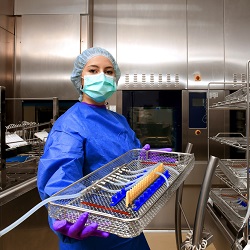
A sterile processing technician is a healthcare professional who is responsible for preparing, sterilizing, maintaining, packaging, and storing medical tools and equipment used in surgical and other medical procedures.
They also assist in the organization of medical supplies and equipment in the surgical unit and other medical settings.
SPD technicians can also work in the field of infection control.
They are responsible for monitoring and controlling the spread of disease and infection by using proper disinfection techniques and proper sterilization protocols.
They may assist in the development and implementation of safety guidelines and protocols, such as the use of personal protective equipment (PPE).
Duties
- Follow protocol and techniques for proper disinfection and sterilization of equipment
- Clean, sterilize, decontaminate, package, and store medical equipment
- Perform inventory checks
- Distribute and organize medical tools
- Control and monitor the spread of disease and infection
- Assist in the development and implementation of safety guidelines and protocols
- Maintain and repair medical tools and equipment
Salary
A sterile processing technician can expect to earn a median annual salary of $48,990.
The lowest-paid central service (CS) professionals earn as little as $35,610, while the highest-paid technicians earn an annual salary of $64,820.
SPD technician’s salary varies based on several factors, including location, education and certifications, work experience, and related skills.
The type and size of the medical facility are also factors.
Annually National Average Salary: $48,990
Average Annual Salary by State
| State | Avg. Annual Salary |
|---|---|
| Alabama | $36,040 |
| Alaska | $54,070 |
| Arizona | $45,530 |
| Arkansas | $37,860 |
| California | $64,820 |
| Connecticut | $48,790 |
| Delaware | $53,090 |
| District of Columbia | $58,410 |
| Florida | $44,290 |
| Georgia | $47,310 |
| Hawaii | $50,590 |
| Idaho | $48,000 |
| Illinois | $50,250 |
| Indiana | $43,110 |
| Iowa | $42,550 |
| Kansas | $43,630 |
| Kentucky | $44,130 |
| Louisiana | $36,200 |
| Maine | $46,230 |
| Maryland | $49,330 |
| Massachusetts | $55,060 |
| Michigan | $45,330 |
| Minnesota | $49,900 |
| Mississippi | $35,610 |
| Missouri | $44,210 |
| Montana | $43,100 |
| Nebraska | $42,880 |
| Nevada | $45,680 |
| New Hampshire | $49,290 |
| New Jersey | $52,640 |
| New Mexico | $42,940 |
| New York | $52,860 |
| North Carolina | $43,750 |
| North Dakota | $48,220 |
| Ohio | $43,460 |
| Oklahoma | $42,060 |
| Oregon | $50,550 |
| Pennsylvania | $45,200 |
| Rhode Island | $52,300 |
| South Carolina | $42,510 |
| South Dakota | $40,400 |
| Tennessee | $43,950 |
| Texas | $46,100 |
| Utah | $46,170 |
| Vermont | $48,010 |
| Virginia | $46,690 |
| Washington | $54,210 |
| West Virginia | $42,540 |
| Wisconsin | $45,800 |
| Wyoming | $47,020 |
| Guam | $42,540 |
| Puerto Rico | $26,650 |
Annual Average Salary: Top 5 States
The top earning state in the field is California, where the average salary is $64,820.
These are the top 5 earning states in the field:
* Employment conditions may vary by location.
Step-by-Step Guide to Becoming a Sterile Processing Technician
Step 1 Obtain a High School Diploma or GED
Since SPD technicians must have a basic understanding of medical terminology and concepts, having a high school diploma or GED is essential.
Consider enrolling in a program that can help you obtain your GED if you don’t already have one.
Having a high school diploma or GED is important for a Sterile Processing Technician because it demonstrates that the student has the basic academic skills needed to succeed in the career.
Taking courses in health sciences, medical terminology, and anatomy can help prepare you for a career as a sterilization technician.
Additionally, courses in biology and chemistry can help you gain a better understanding of how the equipment used in the Sterile Processing Department works.
Courses in computer science and technology would also prove beneficial as they offer an opportunity to familiarize yourself with the software used by healthcare providers and Sterile Processing units.
Step 2 Earn a Postsecondary Certificate
To ensure you have a long and meaningful career as a sterile processing technician, your next step should be to enroll in a sterile processing technician Training Program.
These programs include courses in medical terminology, sterilization techniques, and medical instrumentation.
Most central service (CS) professionals obtain an Associate’s degree in Sterile Processing.
This degree takes two years to complete and costs an average of $8,000.
Coursework can also be completed online or through a technical or vocational program.
The cost of these programs ranges from $1,6000 to $7,000 and takes between three months and two years to complete.
These courses cover a variety of subjects, including:
- Anatomy and physiology
- Microbiology
- Medical and surgical terminology
- Decontamination and sterilization
- Cleaning and disinfection
- Infection control and prevention
- Using and storing surgical tools
- Inventory management
Step 3 Complete Clinical Internship
In order to complete your coursework, you will also be required to take part in a clinical internship.
The number of required hours varies by state and education program and ranges from 250-400 hours.
Internships must be done at a hospital or medical facility approved by your educator.
A clinical internship is an invaluable opportunity for anyone aspiring to become a sterile processing technician.
These internships are a chance to gain critical skills and knowledge that only hands-on experience can offer.
There, you will learn the intricacies of your new profession, build professional relationships, gain valuable experience working with patients, and practice your skills in a real-world environment.
Step 4 Take Your Professional Certification Examination
Once you’ve completed the required coursework and internship hours, you’ll want to consider taking the exam to become a Certified Registered Central Service Technician (CRCST).
While many states do not require professional certification, obtaining this certificate can help solidify and advance your career as a sterile processing technician.
There are two main accrediting organizations that offer certification for sterile processing technicians: the Certification Board for Sterile Processing and Distribution (CBSPD) and the Healthcare Sterile Processing Association (HSPA) (formerly known as the International Association of Healthcare Central Service Materiel Management).
Before you begin studying for the examination, it’s important that you research the accrediting body’s requirements.
Each organization has its own unique set of prerequisites and work experience demands.
Step 5 Join Professional Organizations and Pursue Additional Educational Opportunities
Joining professional organizations provides sterile processing technicians with the opportunity to connect with other professionals in their field and stay informed of industry developments.
These organizations include:
- Healthcare Sterile Processing Association (HSPA)
- Association of Surgical Technologists (AST)
- Association for the Advancement of Medical Instrumentation® (AAMI)
- The SPD Network
Many sterile processing technicians use their position as a stepping stone on their path toward their ultimate goal in the medical field.
If professional development is in your future, the following positions should be considered:
- Sterile Processing Supervisor
- Sterile Processing Technologist
- Surgical Technologist
- Clinical Medical Assistant
- Surgical Technician
- Registered Nurse (RN)
- Licensed Practical Nurse (LPN)
Recommended Programs
Sterile Processing Technician Education and Requirements
To become a central service technician, individuals should have a high school diploma or GED and be able to demonstrate the technical abilities and skills necessary to effectively perform the job.
Additionally, most employers will only consider applicants who have some type of postsecondary educational background, such as a certificate or Associate’s degree from an accredited college or university.
In addition to formal education, sterile processing technicians must also possess a good understanding of medical terminology and aseptic techniques.
They must log the required number of internship hours, where they have a proven track record of being able to identify and troubleshoot common sterilization and storage problems.
Finally, sterile processing technicians should have strong organizational skills and the ability to work independently.
Career Video Overview
Certification and Licensing
Sterile processing technicians seeking certification can choose one of two pathways for obtaining their certificate.
The two accrediting bodies that offer certification for sterile processing technicians are the Certification Board for Sterile Processing and Distribution (CBSPD) and the Healthcare Sterile Processing Association (HSPA).
Regardless of which organization you decide to seek certification through, you will need to take and pass the Certified Registered Central Service Technician (CRCST) examination.
This test assesses your skills and knowledge of medical terminology, sterilization techniques, and medical instrumentation.
Both certifications have an annual renewal period in which you will be required to take continuing education courses.
Obtaining a CBSPD or HSPA certification is an excellent way to increase both earning and professional employment opportunities.
Currently, HSPA offers several certification categories:
- Certified Registered Central Service Technician (CRCST)
- Certified Instrument Specialist (CIS)
- Certified Endoscope Reprocessor (CER)
- Certified Healthcare Leader (CHL)
- Certified Central Service Vendor Partner (CCSVP)
The CBSPD currently offers the following certifications:
- Certified Registered Central Service Technician (CRCST)
- Certified Ambulatory Surgery Technician (CASSPT)
- Certified Flexible Endoscope Reprocessor (CFER)
- Sterile Processing Management Certification (CSPM)
- Surgical Instrument Specialist Certification (CSIS)
Typical Training Program Length: 0-1 Year
Job Outlook and Growth for Sterile Processing Technicians
The job outlook for sterile processing technicians is very positive.
According to a recent study by the U.S. Bureau of Labor Statistics, employment of sterile processing technicians is projected to grow 10% from 2024 to 2034.
These numbers are much higher than the average for most other occupations.
This projected growth is mainly due to the aging population and the need for more medical procedures.
Additionally, the demand for sterile processing technicians is expected to increase as more hospitals, outpatient surgery centers, and other healthcare facilities are built.
With the increasing demand for sterile processing technicians, the salary for these technicians is also projected to rise.
10-Year Employment Growth Rate: 10%
2024
2034
That's a higher than average projected growth of 7,700.
Should You Become a Sterile Processing Technician?
Overall Satisfaction: High

It is a challenging career that requires attention to detail and a thorough understanding of medical terminology, anatomy, and medical procedures.
It is also a rewarding career that provides an opportunity to serve and help others.
They work in a fast-paced, ever-changing environment and are often the first line of defense in controlling and preventing the spread of disease and infection.
With the right training, they can provide a valuable service to the medical community and help to ensure the safety of patients and staff.
Average Salary: Medium

When broken down by region, the median salary for sterile processing technicians ranges from a low of $35,610 in the South to a high of $64,820 in the West Coast.
The West and Midwest regions have median salaries of $35,030 and $37,820, respectively.
Data from a 2024 survey of central service technicians indicates that, on average, they are satisfied with their salaries.
Over 70% of sterile processing technicians surveyed felt that their salary was either “Good” or “Very Good”.
Additionally, 63% felt their salary would be “Fairly Good” or “Very Good” moving forward.
Only 13% of central service technicians surveyed felt that their salary was either “Bad” or “Very Bad”.
These results suggest that sterile processing technicians are generally satisfied with their average salary, as well as job security.
Job Growth Outlook: High

The future outlook for sterile processing technicians is very positive.
The Bureau of Labor Statistics projects that the job market for this profession will grow by 10% over the next ten years, which is much faster than the average for all occupations.
This job growth should create hundreds of thousands of new jobs in the next few years.
In addition, the median annual salary for sterile processing technicians is $48,990, which is a great starting salary for a healthcare career.
With these factors combined, SPD technicians should feel optimistic about future job growth.
Time to Complete Training: 0-1 Year

Sterile processing technicians have a positive outlook on the profession’s education requirements.
According to a survey conducted in 2022, the majority of technicians feel that their current educational requirements are sufficient and meet their job expectations.
They also cite that the necessary training helps them stay up-to-date on the latest sterile processing techniques and technology.
The majority of technicians feel that the profession’s educational requirements are not overly burdensome, but rather provide them with the fundamental knowledge and skills needed to be successful in their job.
They feel that the profession’s educational requirements are beneficial and supportive of their career.
Personal Skills Needed

- Attention to detail
- Ability to follow instructions
- Good organizational skills
- Ability to stand for long periods of time
- Ability to lift and move heavy objects
- Ability to work in a fast-paced environment
- Good interpersonal and communication skills
- Basic computer literacy
- Ability to think critically and problem solve
- Ability to multitask
Frequently Asked Questions
How Long Do You Have to Go to School to Become a Sterile Processing Technician?
The amount of time required to become a sterile processing technician will vary depending on the training program and your state’s requirements.
Most programs take anywhere from six to twelve months to complete, while universities and community college programs take two years to complete.
Once you’ve fulfilled your education requirements, you will also need to complete an internship program.
The internship length varies by state and educational program.
Some require at least six months of hands-on experience, while others require 250-400 hours.
The great news is that many of these internships pay an hourly wage of $18-$38.
How Much Money Does a Sterile Processing Technician Make a Year?
The median salary for sterile processing technicians is $48,990.
The lowest-paid Central service technicians earn $35,610.
The highest-paid technicians earn an annual salary of $64,820.
Your pay as an SPD technician will vary based on several factors, including location, education and certifications, work experience, and related skills.
The type and size of the medical facility will also be a factor.
What Kind of Education Do You Need to Be a Sterile Processing Technician?
To become a sterile processing technician, you will need to complete a training program through an accredited educational institution.
These programs often include courses in medical terminology, anatomy and physiology, medical instrumentation, and aseptic technique.
Most Sterile Processing Technician programs also require clinical experience to ensure graduates are prepared to enter the field.
Are Sterile Processing Technicians in High Demand?
The future outlook for sterile processing technicians is very positive.
The Bureau of Labor Statistics projects that the job market for this profession will grow by 10% over the next ten years, which is much faster than the average for all occupations.
This job growth should create thousands of new jobs in the next few years.
What Skills Do You Need to Have to Be a Sterile Processing Technician?
In addition to having detailed knowledge of sterilization techniques and procedures, you will also need to be manually dexterous, detail-oriented, and possess strong critical-thinking skills.
Additional required skills include:
- Good communication and organizational skills
- Ability to follow safety protocols and guidelines
- Knowledge of operating room and hospital policies and procedures
- Ability to work with a team and independently
- Ability to take direction
- Ability to lift, move and transport heavy equipment and supplies
- Ability to understand and follow written and verbal instructions
- Ability to multitask and prioritize tasks
- Possess a passion for keeping people safe
 Sterile Processing Technician Info by State

- Alabama
- Alaska
- Arizona
- Arkansas
- California
- Colorado
- Connecticut
- Delaware
- Florida
- Georgia
- Hawaii
- Idaho
- Illinois
- Indiana
- Iowa
- Kansas
- Kentucky
- Louisiana
- Maine
- Maryland
- Massachusetts
- Michigan
- Minnesota
- Mississippi
- Missouri
- Montana
- Nebraska
- Nevada
- New Hampshire
- New Jersey
- New Mexico
- New York
- North Carolina
- North Dakota
- Ohio
- Oklahoma
- Oregon
- Pennsylvania
- Rhode Island
- South Carolina
- South Dakota
- Tennessee
- Texas
- Utah
- Vermont
- Virginia
- Washington
- West Virginia
- Wisconsin
- Wyoming
Sterile Processing Technician Resources
- Sterile Processing Technician Programs & Info
- How Much Does It Cost to Become a Sterile Processing Technician?
- 17 Pros and Cons of Being a Sterile Processing Technician
- 11 Best Online Sterile Processing Technician Training Programs
Discover Additional Medical Careers
Nursing & Patient Care
 Certified Nursing Assistant
Working as a Certified Nursing Assistant is an entry-level role that will give you hands-on experience when you are ready to take the next step in your medical career.
 Dental Hygienist
Dental hygienists take care of cleaning teeth to promote hygiene and help avoid cavities and gum problems.
 EMT
EMTTrained emergency medical technician that arrives at the scene to provide medical services such as resuscitation.
 Home Health Aide
Home health aides provide home care to individuals who require assistance in their day-to-day living.
 Licensed Practical Nurse (LPN)
Licensed Practical Nurses provide basic nursing care to patients and work with Registered Nurses and Doctors.
 Nurse Practitioner
A Nurse Practitioner can diagnose, treat, counsel, and prescribe medications to patients in hospitals or doctors’ offices.
 Patient Care Technician
Patient care techs work directly with patients helping them with daily activities and assist the medical staff by measuring and monitoring the patients' vital signs among other tasks.
 Physical Therapist Assistant
Physical therapist assistants provide physical therapy services to patients and aide to physical therapists.
 Professional Recovery Coach
A professional recovery coach is a life coach who works with someone during their addiction recovery process.
 Registered Nurse (RN)
Registered Nurses provide hands-on patient care in various settings, mainly hospitals, and clinics.
Allied Health & Clinical
 Dental Assistant
Dental assistants help dentists to provide patient care, keep records, and care for the dental equipment.
 Dialysis Technician
Dialysis technicians maintain and monitor dialysis equipment, and also act as primary caregivers for patients undergoing dialysis treatment.
 Medical Assistant
Medical assistants support the work of physicians, nurses, and other health professionals.
 Medical Technologist
Medical laboratory technologists collect bodily samples and conduct tests to analyze those samples.
 Mental Health Technician
A Mental Health Technician is a healthcare support professional who assists licensed clinicians in caring for individuals with mental, emotional, or behavioral conditions.
 Nutritionist
As a Nutritionist, you’ll be tasked with creating meal plans, counseling, and understanding dietary restrictions for all types of clients.
 Optician
Opticians are technicians and salespersons at the same time who spends most of their day talking to customers, reading prescriptions written by doctors, and dispensing glasses and lenses.
 Pharmacy Technician
Pharmacy technicians provide patients with medications through prescription or over the counter.
 Phlebotomy Technician
As a Phlebotomist, it will be your responsibility to take blood samples from patients and send them to the lab for further testing.
 Surgical Technologist
Surgical technologists – also known as operating room techs – prepare operating rooms and assist doctors and nurses during surgical procedures.
Imaging & Diagnostic
 MRI Technologist
MRI Technologists use a machine to scan the body and create a detailed image of the inside for doctors to analyze.
 Respiratory Therapist
Respiratory therapists treat and care for patients who experience breathing difficulties.
 Ultrasound Technician
Ultrasound technicians aid physicians in monitoring and diagnosing patients through the use of ultrasonic imaging technology.
 X-Ray Technician
X-Ray Technicians are medical imaging professionals who use technology to visualize the inside of our bodies.
Healthcare Admin & IT
 Healthcare Administrator
Healthcare administrators – also known as healthcare executives or health services managers – are responsible for the planning, direction, and coordination of medical and health services.
 Medical Biller and Coder
Medical billers and coders manage, organize, and code various health information data.
 Medical Office Manager
Medical Office Managers are unseen masters of controlled chaos, juggling the needs of healthcare professionals while keeping the non-clinical side of the office humming.
 Medical Transcriptionist
Medical transcriptionists go over voice recordings to convert them into written texts.
 Patient Access Representative
The work involves helping people to orient themselves to the space and everything that is going on.
 Registered Health Information Technician
Registered Health Information Technician (RHIT) help store and verify accuracy of health records as well as analyze patient data.
Animal Care
 Dog Groomer
Dog groomers attend to grooming dogs, usually at dog salons or big pet-related chain stores.
 Veterinary Assistant
Veterinary Assistants work closely with Veterinarians to handle routine animal care.
 Vet Office Manager
Veterinary office managers work to make sure that the daily operations run smoothly and efficiently at veterinary hospitals or veterinary clinics.
 Veterinary Technician
Veterinary Technicians assist veterinarians as well as diagnosing and treating animals, mostly in private clinics.