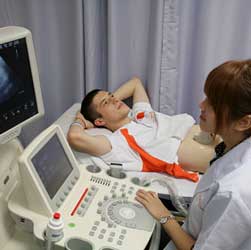









What is an Ultrasound Technician?
As an Ultrasound Technician, it’s possible that you can work with many different people, or follow a niche career, like working with pregnant women.
There are Ultrasound Technicians who work with cardiologists, as well as in vascular care, so the type of Ultrasound Technician you choose to be is up to you.
This career is important, as Ultrasound Technicians help prepare patients for procedures and operations, as well as assist with diagnosing and examining issues within the body.
Using ultrasound technology, an Ultrasound technician takes an instrument called a transducer and places it on patients’ bodies to create images of the inside of their body.
Duties
No day is the same for an Ultrasound Technician, as there are many things that they must do throughout the day.
On average, you can find an Ultrasound Technician:
- Perform ultrasounds with a transducer
- Maintain ultrasound equipment
- Explain the procedure to the patient
- Evaluate images from the ultrasound
- Present images and findings to the doctor or medical team
- Maintain patient records
Salary
On average, people in the United States make around $92,550 as an Ultrasound Technician.
This is after a couple of years of experience, as well as a degree.
Those who are just beginning their career as Ultrasound technicians can expect to make closer to $64,000 a year.
After earning certification as an Ultrasound Technician, as well as several more years of experience and even a higher degree, it’s possible to make up to $123,000 a year as an Ultrasound Technician.
Annually National Average Salary: $97,240
Average Annual Salary by State
| State | Avg. Annual Salary |
|---|---|
| Alabama | $69,160 |
| Alaska | $106,180 |
| Arizona | $99,050 |
| Arkansas | $83,360 |
| California | $126,610 |
| Colorado | $108,310 |
| Connecticut | $104,380 |
| Delaware | $98,240 |
| District of Columbia | $114,040 |
| Florida | $85,990 |
| Georgia | $84,910 |
| Hawaii | $118,090 |
| Idaho | $95,630 |
| Illinois | $98,730 |
| Indiana | $86,070 |
| Iowa | $87,840 |
| Kansas | $92,970 |
| Kentucky | $88,940 |
| Louisiana | $80,500 |
| Maine | $95,370 |
| Maryland | $97,230 |
| Massachusetts | $113,410 |
| Michigan | $83,010 |
| Minnesota | $102,540 |
| Mississippi | $74,770 |
| Missouri | $94,550 |
| Montana | $99,350 |
| Nebraska | $86,220 |
| Nevada | $98,350 |
| New Hampshire | $107,460 |
| New Jersey | $103,800 |
| New Mexico | $89,390 |
| New York | $104,990 |
| North Carolina | $87,500 |
| North Dakota | $87,020 |
| Ohio | $85,290 |
| Oklahoma | $84,880 |
| Oregon | $115,390 |
| Pennsylvania | $86,130 |
| Rhode Island | $98,390 |
| South Carolina | $85,540 |
| South Dakota | $77,220 |
| Tennessee | $81,730 |
| Texas | $88,940 |
| Utah | $96,590 |
| Vermont | $106,860 |
| Virginia | $95,220 |
| Washington | $115,060 |
| West Virginia | $80,040 |
| Wisconsin | $103,150 |
| Wyoming | $101,160 |
| Puerto Rico | $53,680 |
Annual Average Salary: Top 5 States
The top earning state in the field is California, where the average salary is $126,610.
These are the top 5 earning states in the field:
* Employment conditions may vary by location.
How to Become an Ultrasound Technician
Step 1 Get an Education
It’s not legally required to possess a degree in order to work as an Ultrasound Technician, but many employers do prefer to hire ones that do.
The most common type of degree is an Associate’s degree in diagnostic medical sonography, which takes about two years to finish.
In this type of program, you will learn all kinds of information about ultrasound and sonography procedures, as well as how to care for patients.
A typical Associates degree program will have courses that include:
- Sonography and Ethics
- Abdominal Sonography
- Sectional Anatomy
- Obstetrics and Gynecological Sonography
- Culture and Diversity
Keep in mind that any program you seek should be accredited by the Commission on Accreditation of Allied Health Education Programs.
Some Ultrasound Technicians choose to earn a Bachelor’s degree, which takes about four years to finish.
In a Bachelor’s degree program, you’ll take the required sonography courses but also have courses like English and math.
Step 2 Gain Experience
While getting a formal education is not mandatory, it’s crucial that you gain hands-on experience as an Ultrasound Technician, especially if you would like to become certified at some point.
To gain experience, you’ll need to find a job.
Most hospitals and doctor’s offices need new Ultrasound Technicians, but it’s possible to work in clinics as well as at private ultrasound companies.
Having at least two years of experience is preferred before you can try to become certified.
Enrolling in an internship while going through an Associate’s degree program is a great way to learn the tricks of the trade and gain experience while going to school.
You could also shadow another Ultrasound Technician or even volunteer at your local hospital.
Step 3 Become Certified
Once you have a couple of years of experience, something may push you to become a Certified Ultrasound Technician.
There are many areas that an Ultrasound Technician can gain certification from the American Registry for Diagnostic Medical Sonography:
- Abdomen
- Breast
- Echocardiography
- OB/GYN
- Vascular
In order to gain these certifications, you must be a part of the ARDMS and take an exam.
The American Registry for Radiologic Technologists offers 15 different certifications including:
- Mammography
- Registered Radiologist Assistant
- Nuclear Medicine Technology
- Radiography
The Cardiovascular Credentialing International Association offers:
- Certified Cardiac Sonographer
- Advanced Cardiac Sonographer
- Registered Cardiac Sonographer
In order to earn these certifications, you must be enrolled in the association that they are from, and also take an exam to show your competence in the field of sonography.
Step 4 Further Your Career
Becoming certified and gaining education over the years can mean that you want to step out into another career, or gain promotion in your current field.
Having many credentials can help with gaining raises and promotions, but there are some other things that you can do to help further your career.
The first is to pick a specialty, that way you know which direction you want to go into.
Network with others in the community and try and see what other possibilities are out there.
Beyond an Ultrasound Technician, it’s possible to gain employment as:
- MRI Technologist
- CT Technologist
- Senior Ultrasound Technician
- Operational Supervisor
Earning a Masters degree can also help with promotions, this two-year program could lead to a career in:
- Advanced Sonographer
- Lead Pediatric Cardiac Sonographer
- Sonographer Educator
Recommended Programs
Education
For anyone interested in becoming an Ultrasound Technician, it is smart to think about enrolling in a program.
Most employers prefer that Ultrasound Technicians have at least an Associate’s degree in diagnostic medical sonography.
In order to enroll in an Associates degree program, you must have a high school diploma or equivalent, as well as a 2.5 or higher GPA.
On average, an Associate’s degree takes around two years to finish, but there are some accelerated ones that can take about 12-18 months.
Be wary of ones that aren’t very long, as they could leave out a lot of valuable information and clinical studies time.
Most classes in an Associates degree program will be geared toward science and math, as well as courses like:
- Sonography Ethics and Conduct
- Pathophysiology
- Medical Terminology
- Cross-Sectional Sonography
- Vascular Sonography
No matter the type of program that you decide to enroll in, make sure that there are clinical classes so that you can earn patient care experience.
Beyond an Associate’s degree, many Ultrasound Technicians earn a Bachelor’s degree.
This is a four-year commitment for full-time students, and can lead to promotions or raises as an Ultrasound Technician.
You will likely have the typical English and math classes in this type of program, but you will also take more advanced and detailed sonography classes.
Another way to earn an education for this career is through hands-on experience.
This can be done by enrolling in an internship, shadowing another Ultrasound Technician, and having clinical studies in school.
Once you have several years of experience working as an Ultrasound Technician, you may want to think about entering into a certain niche, whether that be:
- Vascular Technology
- Mammography
- OB/GYN Ultrasounds
After deciding on a specialty, looking into certification is the next step toward a great career as an Ultrasound Technician.
Career Video Overview
Certification
It can take a couple of years of experience to be able to earn a certification as an Ultrasound Technician, but if you are serious about your role, you should consider one.
Several organizations offer Ultrasound Technician certification, so make sure you find an accredited one.
Some of the most popular are:
- American Registry for Diagnostic Medical Sonography
- American Registry for Radiologic Technologists
- Cardiovascular Credentialing International Association
Each one requires that you become a member, but this opens up a huge network of people to help you in your career.
After becoming a member of the respective association, you can begin looking into the prerequisites for credentials.
There are many different certifications to choose from through each association.
Through the American Registry for Diagnostic Medical Sonography, there are specializations in different areas of the body, including:
- Abdomen
- Mammography
- Gynecology
Most of the exams are year-round for this organization, and all of them are multiple-choice tests.
On average, the exams take two hours to complete, with about 150 questions each.
All of these certifications require recertification after 5 years.
Check out the website for more information.
The American Registry for Radiologic Technologists has another variety of credentials, including:
- Sonography
- Mammography
- Radiation Therapy
- Magnetic Resonance Imaging
- Cardiac Interventional Sonography
Through this association, you will only take one exam, regardless of the area that you want to specialize in.
The only difference is the education that you receive for that certification.
The exam is computer-based and can be taken at home or in one of the many facilities across the United States.
To be accepted into this organization, you must have good moral and ethical standing.
The other association, the Cardiovascular Credentialing International Association, has its own certifications:
- Registered Congenital Cardiac Sonographer
- Advanced Cardiac Sonographer
- Registered Phlebotomy Sonographer
These credentials can be acquired by taking an exam and paying the $100 testing fee.
Each certification will have its own categories based on the specialization.
Some of the topics that you can expect on most of the exams are:
- Echocardiography
- Pre-Procedural Activities
- Post-Procedural Activities
- Stress Tests
The Cardiovascular Credentialing International Association website has much more information about these certifications.
Ultrasound Technician Requirements: States With Mandatory Licensure
| State | Core Requirements |
|---|---|
| New Hampshire | Graduation from an accredited diagnostic medical sonography program (CAAHEP or equivalent), National certification (typically ARDMS, ARRT, or CCI), State license application and fees |
| New Mexico | Completion of an approved or accredited ultrasound program, National certification required (ARDMS or equivalent), Application through the New Mexico Medical Imaging & Radiation Therapy Program |
| North Dakota | Graduation from an accredited ultrasound program, National certification (ARDMS, ARRT, or CCI), License application through the North Dakota Medical Imaging Board |
| Oregon | Completion of an accredited diagnostic medical sonography program, National certification required (ARDMS or ARRT), Background check, License application through the Oregon Board of Medical Imaging |
Licensure Disclaimer: Most U.S. states do not require ultrasound (diagnostic medical sonography) technicians to hold a state-issued license. In non-licensure states, employment requirements are set by employers and typically include completion of an accredited program and national certification (such as ARDMS, ARRT, or CCI). Only the states listed below currently mandate state licensure or formal registration for ultrasound technicians.
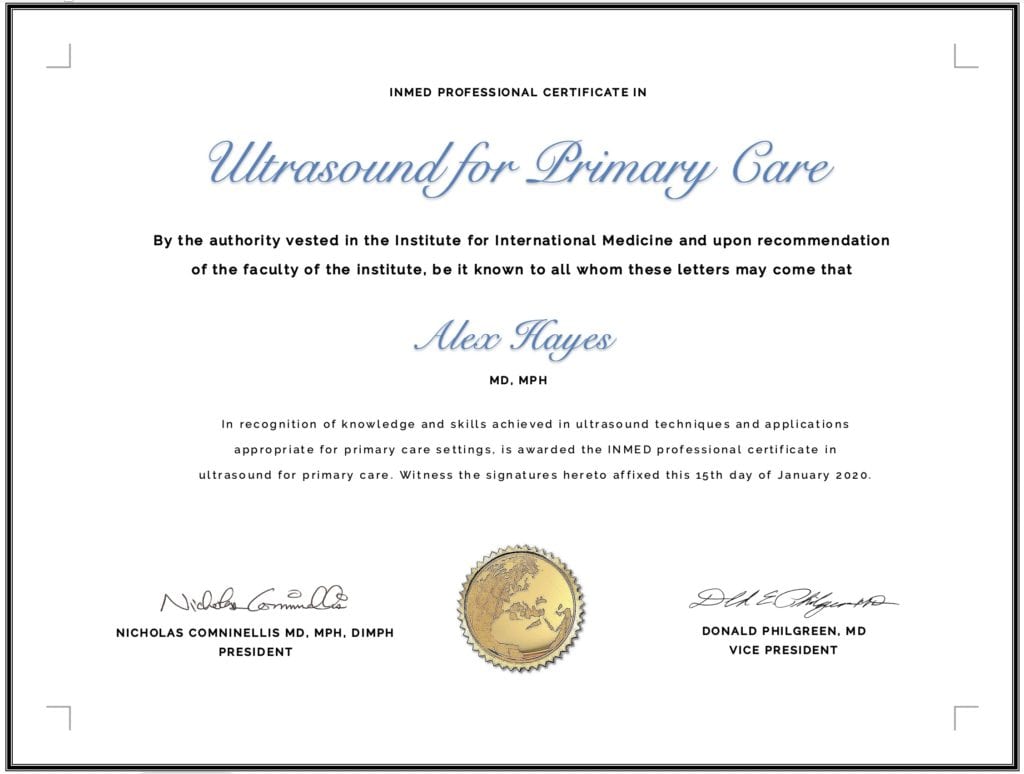
Example of a Professional Certification:
Typical Training Program Length: 2-4 Years
In order to gain most certifications as an Ultrasound Technician, you must have at least two years of experience in the field.
This is so that employers, as well as patients, know that you are competent in what you are doing.
An Associate’s degree can take around two years to finish and can give you the education needed to have a successful career as an Ultrasound Technician.
There are other programs that can help with certification, such as practice tests, but the best program for this career is a hands-on experience.
Job Outlook
Overall, this career will continue to grow over the next ten years.
It looks as if the career of an Ultrasound Technician, as well as other types of medical technicians, will grow by around 19 percent over the next decade.
This is much faster than other occupations in the medical field.
The reason for this rise is that technological advancements have made it easier for medical sonographers and Ultrasound Technicians to see various issues within the body.
Not only do Ultrasound Technicians check fetuses, but they can also work with cardiology and vascular areas.
Due to the aging baby boomer generation, there will likely be a need for more medical treatments, as well as medical conditions like blood clots and heart attacks increasing with this aging generation.
Ultrasound Technicians who are certified will likely find the best job opportunities.
10-Year Employment Growth Rate: 13%
2025
2035
That's a higher than average projected growth of 11,700.
Should You Become an Ultrasound Technician?
Overall Satisfaction: High

It seems that there are many things in this career that Ultrasound Technicians love, like that it is the least stressful job of the medical profession, and great job benefits.
Helping people and taking care of patients is also a joy in this career.
However, there are fewer job advancement opportunities than in other career hospitals or doctors’ offices.
Those who are interested in this career will find more satisfaction when earning certification or stepping into a specialization.
This is due to potential promotions and salary raises.
Average Salary: High

Most Ultrasound Technicians working in the United States will make about $92,550 a year after having a couple of years of experience in the field.
When just starting in this career, it’s typical that the salary for an Ultrasound Technician is closer to $64,000 a year.
However, once you have several years of experience, certifications, and even specializations, this career can garner over $123,000 a year in salary in some places.
Those who work in large populations or in areas with higher socioeconomic statuses will likely make more than people working in small towns or rural areas.
Job Growth Outlook: High

Those who are interested in working as Ultrasound Technicians shouldn’t have to worry about finding a job anytime soon.
This is because this career is due to rise by around 13 percent over the next decade.
Technological advancements have made it easier to use ultrasounds to diagnose a variety of illnesses.
Also, many more preparations are made through ultrasounds for pregnant women, as well as people with cardiac issues and vascular problems.
If you are looking to start a career as an Ultrasound Technician, now is the time.
Keep in mind that job prospects go to those with a certification most often.
Time to Complete Training: 2-4 Years

Ultrasound Technicians should have at least an Associate’s degree, but many employers are now requiring a Bachelor’s degree to work as an Ultrasound Technician.
An Associate’s degree can take about two years to finish for full-time students.
A Bachelor’s degree takes a bit longer, at around four years for full-time students.
Earning a certification can take a few weeks as well.
Depending on the requirements of your employer, it can take anywhere from 2 to four years or more to become an Ultrasound Technician.
Personal Skills Needed

In order to be a great Ultrasound Technician, there are certain personality traits that you must possess.
Along with keeping patient information confidential, it’s important to have a professional manner.
This can be a stressful career, however, with these traits you can become a success:
- Ability to care for others
- Great bedside manner
- Fast learner
- Listening skills
- Mental strength
- Stamina
- Ability to lift over 50 pounds
- Detail-oriented
- Compassion and interpersonal skills
- Hand-eye coordination
- Knowledge of the medical field
- Ability to work with others and alone
- Multi-tasking skills
Frequently Asked Questions
What is the average salary of an Ultrasound Technician?
Most Ultrasound Technicians across the United States make about $92,550 a year.
Having experience and further education can lead to an even bigger salary, up to $123,000 in some areas.
Just starting, though, you shouldn’t expect such a high rate.
Most new Ultrasound Technicians make closer to $64,000 a year.
After certifications and specializations, the salary and promotions can increase for Ultrasound Technicians, especially in larger populations.
How long does it take to become an Ultrasound Technician?
Employers prefer an Associate’s degree in this career. however, it’s not completely necessary.
Ultrasound Technicians who enroll in an Associates degree program should expect it to take about two years to finish.
There are other degrees online and at community colleges that can take anywhere from one year to 18 months to complete.
Earning a Bachelor’s degree can take around four years.
Depending on the program you enter and the type of degree you’d like to receive, it can take anywhere from 1 year to 4 years to become an Ultrasound Technician.
What does an Ultrasound Technician do?
There are many different types of Ultrasound Technicians, so it’s possible that you may do something completely unique to what other Ultrasound Technicians do.
Some of the things that you can expect to do as an Ultrasound Technician include:
Making sure that patients are ready for their appointment.
Preparing the imaging equipment.
Providing diagnostic images of the specific body part.
Analyzing those images and reporting findings to the doctor.
Those who work in different areas may take images of the abdomen, or work in mammography providing images of breast tissue.
What is the demand for Ultrasound Technicians?
There is a high demand for Ultrasound Technicians all over the United States.
The advancements in technology have made it easier to create images of the inside of the body, which means there are more opportunities for careers in this field.
Another factor in the rise of this field is the aging baby boomer population.
As they grow older, they will need more medical care, including ultrasounds.
This career will look to grow around 13 percent over the next decade, that is a lot more than many other careers in the medical field.
How much does it cost to become an Ultrasound Technician?
Most people who are interested in working as an Ultrasound Technician will earn an Associate’s degree.
On average, an Associate’s degree from a community college can cost around $15,000 to $20,000.
Those who go to a university may pay a little more, depending on where they enroll.
Bachelor’s degrees can cost upwards of $35,000.
Also, certifications can cost anywhere from $100 to $300 per certification.
All in all, it can cost anywhere from $16,000 to over $40,000 to become an Ultrasound Technician.
 Ultrasound Technician Info by State

- Alabama
- Alaska
- Arizona
- Arkansas
- California
- Colorado
- Connecticut
- Delaware
- Florida
- Georgia
- Hawaii
- Idaho
- Illinois
- Indiana
- Iowa
- Kansas
- Kentucky
- Louisiana
- Maine
- Maryland
- Massachusetts
- Michigan
- Minnesota
- Mississippi
- Missouri
- Montana
- Nebraska
- Nevada
- New Hampshire
- New Jersey
- New Mexico
- New York
- North Carolina
- North Dakota
- Ohio
- Oklahoma
- Oregon
- Pennsylvania
- Rhode Island
- South Carolina
- South Dakota
- Tennessee
- Texas
- Utah
- Vermont
- Virginia
- Washington
- West Virginia
- Wisconsin
- Wyoming
Ultrasound Technician Resources
- Do Nurses Need Ultrasound Training?
- The Difference Between Ultrasound and Sonography
- Difference Between an Ultrasound Technician and a Radiologist
- Accredited Sonography Programs
- Certificate in Sonography
- How To Earn Your Ultrasound Technician Degree?
- Why Are Sonographers In Such High Demand?
- Ultrasound Technician Courses
- Ten Reasons To Become An Ultrasound Technician
- Top 5 Paying Medical Imaging Careers
- Types of Medical Imaging
- What Do Ultrasound Technicians Do?
- What is 3D Ultrasound?
- When Was Ultrasound Invented?
- 26 Pros and Cons of Being an Ultrasound Technician
- Ultrasound Technician School Costs
- 14 Best Online Ultrasound Technician Training Programs
Discover Additional Medical Careers
Nursing & Patient Care
 Certified Nursing Assistant
Working as a Certified Nursing Assistant is an entry-level role that will give you hands-on experience when you are ready to take the next step in your medical career.
 Dental Hygienist
Dental hygienists take care of cleaning teeth to promote hygiene and help avoid cavities and gum problems.
 EMT
EMTTrained emergency medical technician that arrives at the scene to provide medical services such as resuscitation.
 Home Health Aide
Home health aides provide home care to individuals who require assistance in their day-to-day living.
 Licensed Practical Nurse (LPN)
Licensed Practical Nurses provide basic nursing care to patients and work with Registered Nurses and Doctors.
 Nurse Practitioner
A Nurse Practitioner can diagnose, treat, counsel, and prescribe medications to patients in hospitals or doctors’ offices.
 Patient Care Technician
Patient care techs work directly with patients helping them with daily activities and assist the medical staff by measuring and monitoring the patients' vital signs among other tasks.
 Physical Therapist Assistant
Physical therapist assistants provide physical therapy services to patients and aide to physical therapists.
 Professional Recovery Coach
A professional recovery coach is a life coach who works with someone during their addiction recovery process.
 Registered Nurse (RN)
Registered Nurses provide hands-on patient care in various settings, mainly hospitals, and clinics.
Allied Health & Clinical
 Dental Assistant
Dental assistants help dentists to provide patient care, keep records, and care for the dental equipment.
 Dialysis Technician
Dialysis technicians maintain and monitor dialysis equipment, and also act as primary caregivers for patients undergoing dialysis treatment.
 Medical Assistant
Medical assistants support the work of physicians, nurses, and other health professionals.
 Medical Technologist
Medical laboratory technologists collect bodily samples and conduct tests to analyze those samples.
 Mental Health Technician
A Mental Health Technician is a healthcare support professional who assists licensed clinicians in caring for individuals with mental, emotional, or behavioral conditions.
 Nutritionist
As a Nutritionist, you’ll be tasked with creating meal plans, counseling, and understanding dietary restrictions for all types of clients.
 Optician
Opticians are technicians and salespersons at the same time who spends most of their day talking to customers, reading prescriptions written by doctors, and dispensing glasses and lenses.
 Pharmacy Technician
Pharmacy technicians provide patients with medications through prescription or over the counter.
 Phlebotomy Technician
As a Phlebotomist, it will be your responsibility to take blood samples from patients and send them to the lab for further testing.
 Sterile Processing Technician
A sterile processing technician is a healthcare professional who is responsible for preparing, sterilizing, maintaining, packaging, and storing medical tools and equipment used in surgical and other medical procedures.
 Surgical Technologist
Surgical technologists – also known as operating room techs – prepare operating rooms and assist doctors and nurses during surgical procedures.
Imaging & Diagnostic
 MRI Technologist
MRI Technologists use a machine to scan the body and create a detailed image of the inside for doctors to analyze.
 Respiratory Therapist
Respiratory therapists treat and care for patients who experience breathing difficulties.
 X-Ray Technician
X-Ray Technicians are medical imaging professionals who use technology to visualize the inside of our bodies.
Healthcare Admin & IT
 Healthcare Administrator
Healthcare administrators – also known as healthcare executives or health services managers – are responsible for the planning, direction, and coordination of medical and health services.
 Medical Biller and Coder
Medical billers and coders manage, organize, and code various health information data.
 Medical Office Manager
Medical Office Managers are unseen masters of controlled chaos, juggling the needs of healthcare professionals while keeping the non-clinical side of the office humming.
 Medical Transcriptionist
Medical transcriptionists go over voice recordings to convert them into written texts.
 Patient Access Representative
The work involves helping people to orient themselves to the space and everything that is going on.
 Registered Health Information Technician
Registered Health Information Technician (RHIT) help store and verify accuracy of health records as well as analyze patient data.
Animal Care
 Dog Groomer
Dog groomers attend to grooming dogs, usually at dog salons or big pet-related chain stores.
 Veterinary Assistant
Veterinary Assistants work closely with Veterinarians to handle routine animal care.
 Vet Office Manager
Veterinary office managers work to make sure that the daily operations run smoothly and efficiently at veterinary hospitals or veterinary clinics.
 Veterinary Technician
Veterinary Technicians assist veterinarians as well as diagnosing and treating animals, mostly in private clinics.